01 / OUTCOME
What are we trying to achieve?
Describe the intended result clearly enough that people can recognize whether it has happened.
New · Eight visual learning cards
Investigate assumptions, evidence and barriers with a five-question field guide and an Executive Coloring Book exercise for adults.
Applied Infrastructure Literacy
Applied Infrastructure Literacy connects an understanding of underlying systems to practical judgment and action.
The connection
Infrastructure Literacy helps us recognize the systems, capital, information, authority, incentives, trust, and institutional relationships beneath visible outcomes.
Applying that understanding means asking what those relationships imply for a real choice. What needs to work? Who can act? Which assumptions need evidence? What should happen next?
A practical starting point
Define the outcome, trace its dependencies, locate decision authority, test the evidence, examine incentives, and assign the next action. The six questions below turn that sequence into a practical review.
Use the five-question decision exercise to build a private checklist of what still needs investigation. These prompts support reflection; they are not a scoring formula.
Describe the intended result clearly enough that people can recognize whether it has happened.
Identify the resources, information, timing, and relationships on which the result depends.
Locate the people with authority to commit resources, resolve a problem, or change the plan.
Separate observed facts from expectations. Identify the information needed to test an important assumption.
Consider what people are rewarded for, what they risk, and where their priorities may differ.
Name an action, a responsible person, and the evidence that would show whether it worked.
A worked example
An illustrative business scenario, not an excerpt from the book or a report about a particular company.
The sales team sees growth. Operations needs more material, employees need clear schedules, and the customer expects a firm delivery date. The larger order creates a decision about the whole operating system.
The business needs materials, supplier capacity, production time, quality checks, transport, and enough cash to cover costs before customer payment. The order’s value alone does not establish that these pieces are ready.
In this example, a reward for winning orders can encourage sales to promise an early delivery date before operations checks capacity. The promise then becomes a production commitment the business may be unable to meet. Trace the incentive, the behavior it encourages, and the resulting execution risk.
Identify who may confirm the delivery date, approve additional spending, and resolve the conflict. A joint review before the promise connects sales goals to delivery capability. Why Good Plans Need Operating Structure develops this connection.
Check supplier commitments, available production capacity, payment timing, and the customer’s requirements. Distinguish confirmed arrangements from estimates. A hopeful delivery date is still an assumption until the supporting steps have been examined.
One possible next step is a joint review by sales, operations, and the person responsible for cash planning before making the final delivery commitment. Record who owns each unresolved dependency and when it will be checked again.
The practical shift: Move from “Is this a good order?” to “Under what conditions can we fulfill this order successfully?”
Banking Infrastructure Literacy in practice
Hypothetical organizing-board exercise. These questions illustrate the framework; they do not prescribe a regulatory filing sequence.
A proposed community bank has a target opening date. Its board must decide whether the current plan supports that commitment. Use the following review to connect authority, capability and evidence.
The resulting decision record should explain what is ready, what remains conditional and why the board chose its next step. Advisers can help assemble the work; the record should still identify the institution’s responsible decision makers.
Explore the banking framework · Read: Why Good Plans Need Operating Structure
Financial Infrastructure Literacy in practice
Hypothetical business exercise.
A company wins more orders while its cash balance tightens. Before choosing a response, map the route from customer commitment through materials, production, delivery, invoicing and collection.
Compare the available choices and record their tradeoffs. Revisit the decision when actual deliveries and collections replace the estimates.
Use the Sales Are Up. Why Is Cash Tight? exercise and worksheet · Explore the financial framework
Carry the thinking forward
A brief written record makes the reasoning easier to revisit when conditions change. It can also help other people understand why an action was chosen.
Explore the underlying ideas
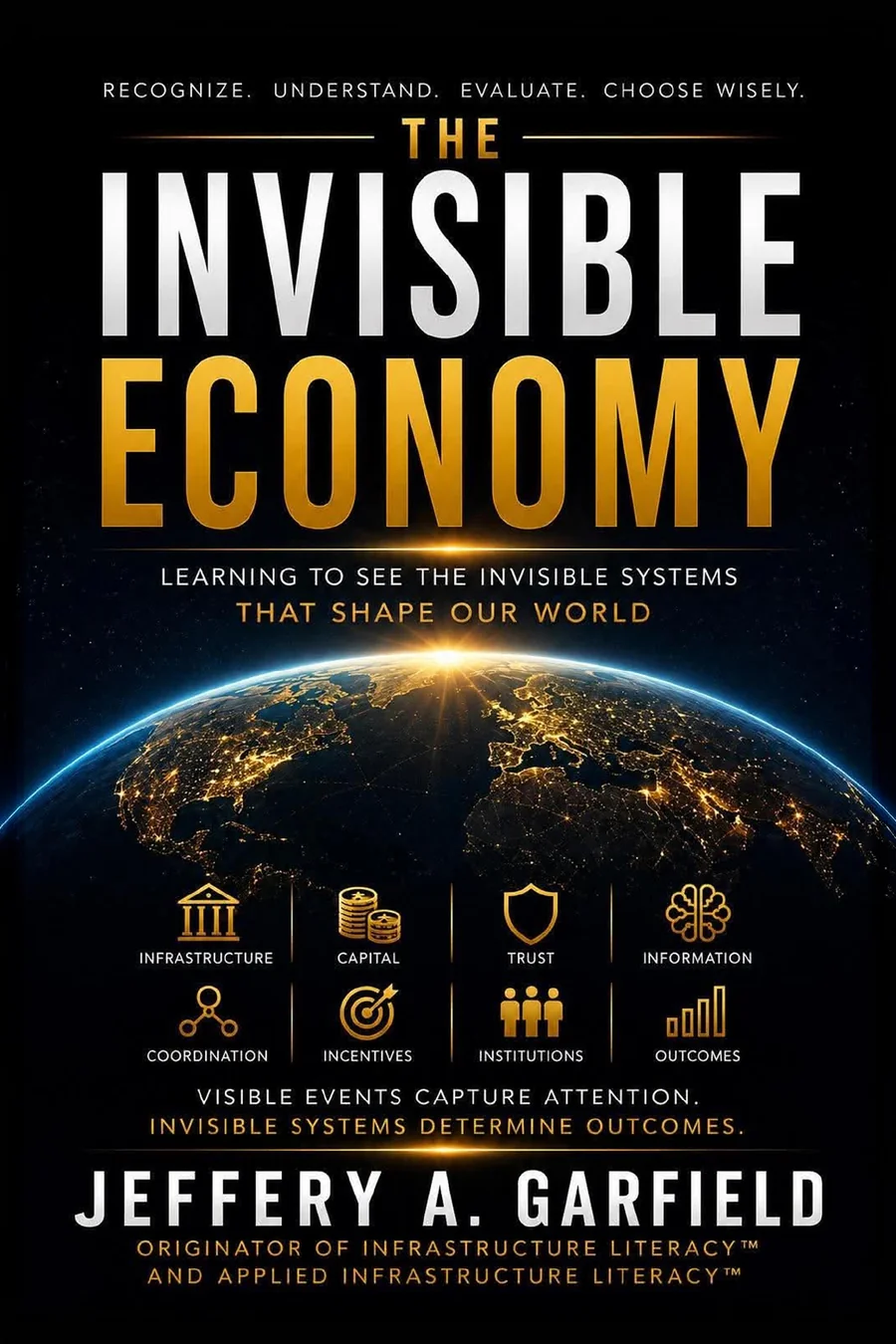
Learning to See the Invisible Systems That Shape Our World
Jeffery A. Garfield is the author of The Invisible Economy and a consultant specializing in de novo bank formation. His writing explores the systems and institutional relationships beneath visible outcomes.
Common questions
Infrastructure Literacy develops recognition and understanding of underlying systems. Applied Infrastructure Literacy connects that understanding to practical judgment and action.
The questions can be used wherever outcomes depend on resources, information, authority, incentives, trust, and coordination. The example on this page uses an ordinary business decision to make those relationships visible.
No. Evidence can be incomplete and conditions can change. The purpose is to make dependencies and assumptions more visible so a decision can be examined and revised thoughtfully.