One idea.
More ways to see it.
Start with a map. Follow a story. Read the ideas at your own pace. Each format offers a way to look beneath everyday outcomes and notice the systems that make them possible.
New · Eight visual learning cards
Before you decide you can’t, trace the system.
Investigate assumptions, evidence and barriers with a five-question field guide and an Executive Coloring Book exercise for adults.
Look beyond the outcome.
Eight connected themes. Eight questions to bring to the world around you.
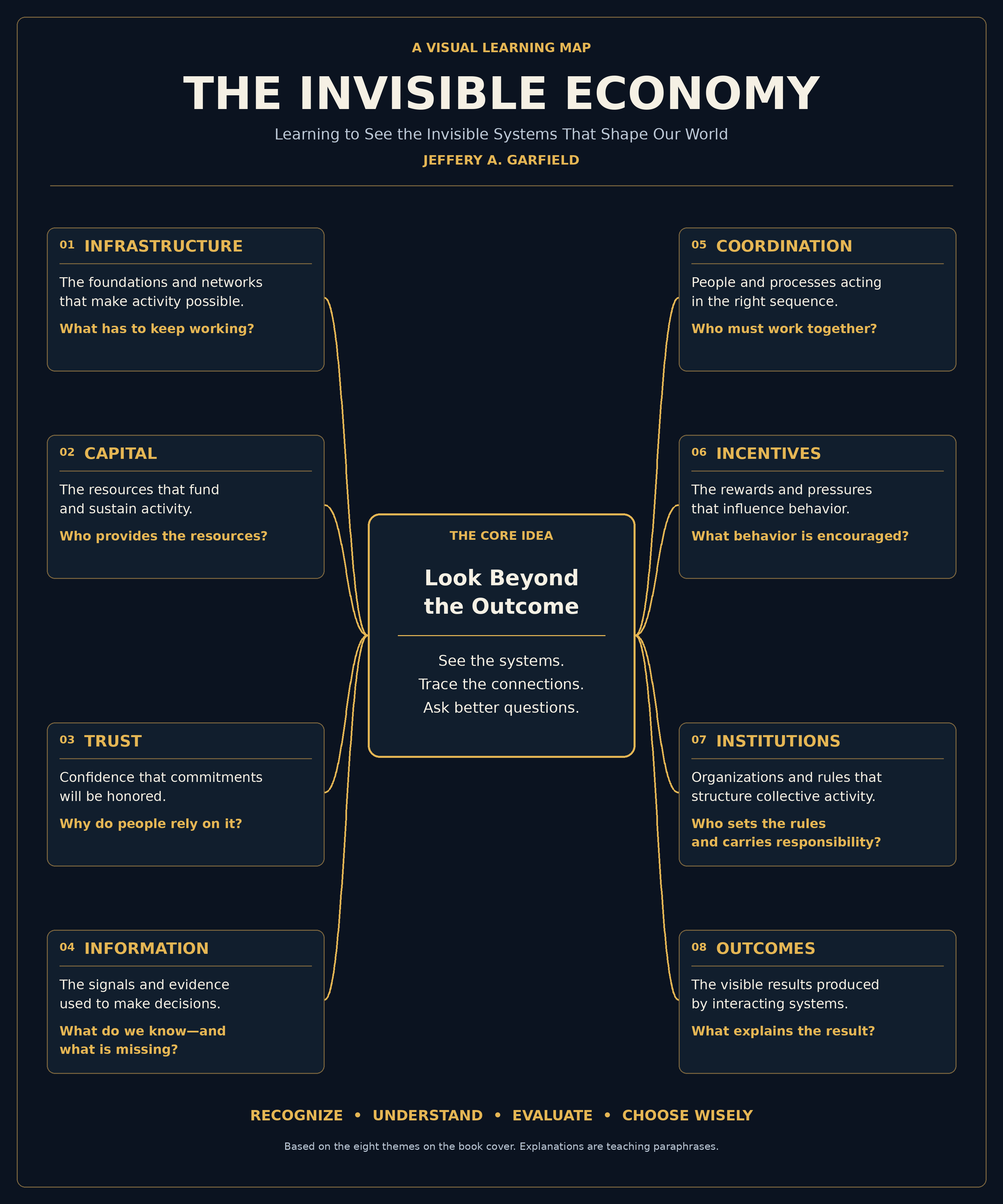
Original PNG · 3000 × 3600 pixels · 300 DPI. Tap the image to open it at full size.
Read the eight themes and questions
The core idea: Look beyond the outcome. See the systems. Trace the connections. Ask better questions.
- 01 Infrastructure
- The foundations and networks that make activity possible.What has to keep working?
- 02 Capital
- The resources that fund and sustain activity.Who provides the resources?
- 03 Trust
- Confidence that commitments will be honored.Why do people rely on it?
- 04 Information
- The signals and evidence used to make decisions.What do we know—and what is missing?
- 05 Coordination
- People and processes acting in the right sequence.Who must work together?
- 06 Incentives
- The rewards and pressures that influence behavior.What behavior is encouraged?
- 07 Institutions
- Organizations and rules that structure collective activity.Who sets the rules and carries responsibility?
- 08 Outcomes
- The visible results produced by interacting systems.What explains the result?
Recognize. Understand. Evaluate. Choose wisely.
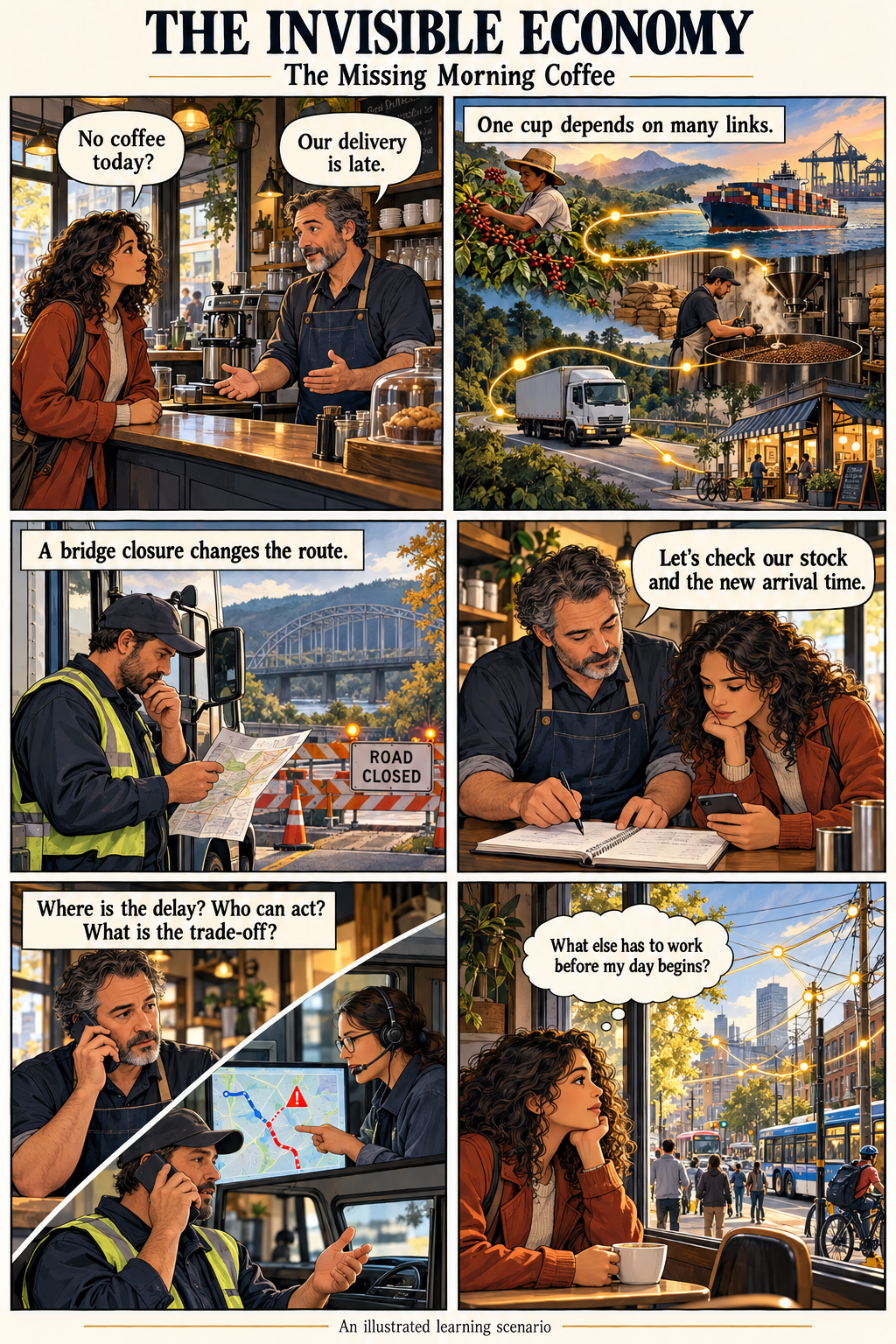
The Missing Morning Coffee.
A late delivery opens a window onto the people, information and infrastructure behind a familiar routine.
An original fictional learning scenario. Read the panels from left to right, then move down.
Read the six-panel story and dialogue
The missing cup
At the café, a customer asks, “No coffee today?” The owner replies, “Our delivery is late.”
The connections
“One cup depends on many links.” The illustration connects a grower, a cargo ship, a roaster, a delivery truck and the café.
The disruption
“A bridge closure changes the route.” A driver checks a map beside a road closure.
The information
Back at the café: “Let’s check our stock and the new arrival time.” The owner and customer examine a notebook and phone.
The coordination
The owner, driver and dispatcher communicate. The caption asks: “Where is the delay? Who can act? What is the trade-off?”
The wider view
Looking out at the city, the customer wonders: “What else has to work before my day begins?”
Headlines. Household budgets. Hidden connections.
Explore three short videos—from market expectations to the systems behind a grocery receipt—with questions and related readings.
Color the systems. Question the connections.
Two hands-on activities for adult learners, workplace discussions and university settings. Color, label or describe what you see, then choose a next step supported by evidence.

Why didn’t my paycheck arrive? →
Follow the sequence. Mark the evidence. Find the next question.
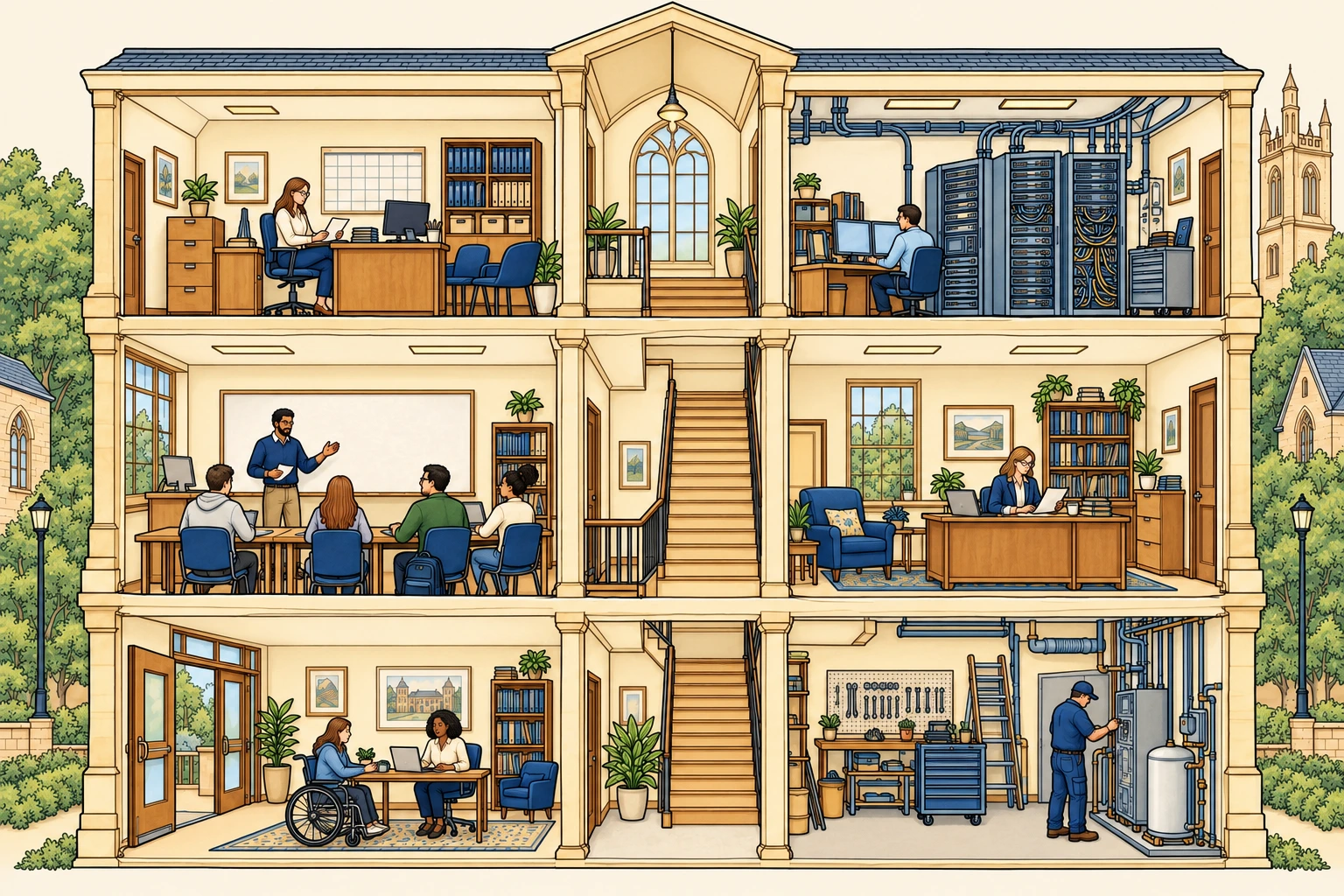
What makes one class possible? →
Explore six supporting functions and test a disruption.
Printable cream, navy and gold pages with room for your notes. Both activities also have full explanations on the website.
Choose one ordinary moment.
A payment. A parcel. A meeting. A morning cup of coffee. Begin with the result you can see, then ask:
- 01
What has to keep working?
List the people, tools, networks and rules the outcome depends on.
- 02
Where could the connection break?
Look for a missing handoff, a delay or information someone does not have.
- 03
What would you check before acting?
Identify the evidence you need, who can help and the trade-offs to consider.
Explore the broader idea in Infrastructure Literacy and its practical use in Applied Infrastructure Literacy.