“I’m just not good with money.”
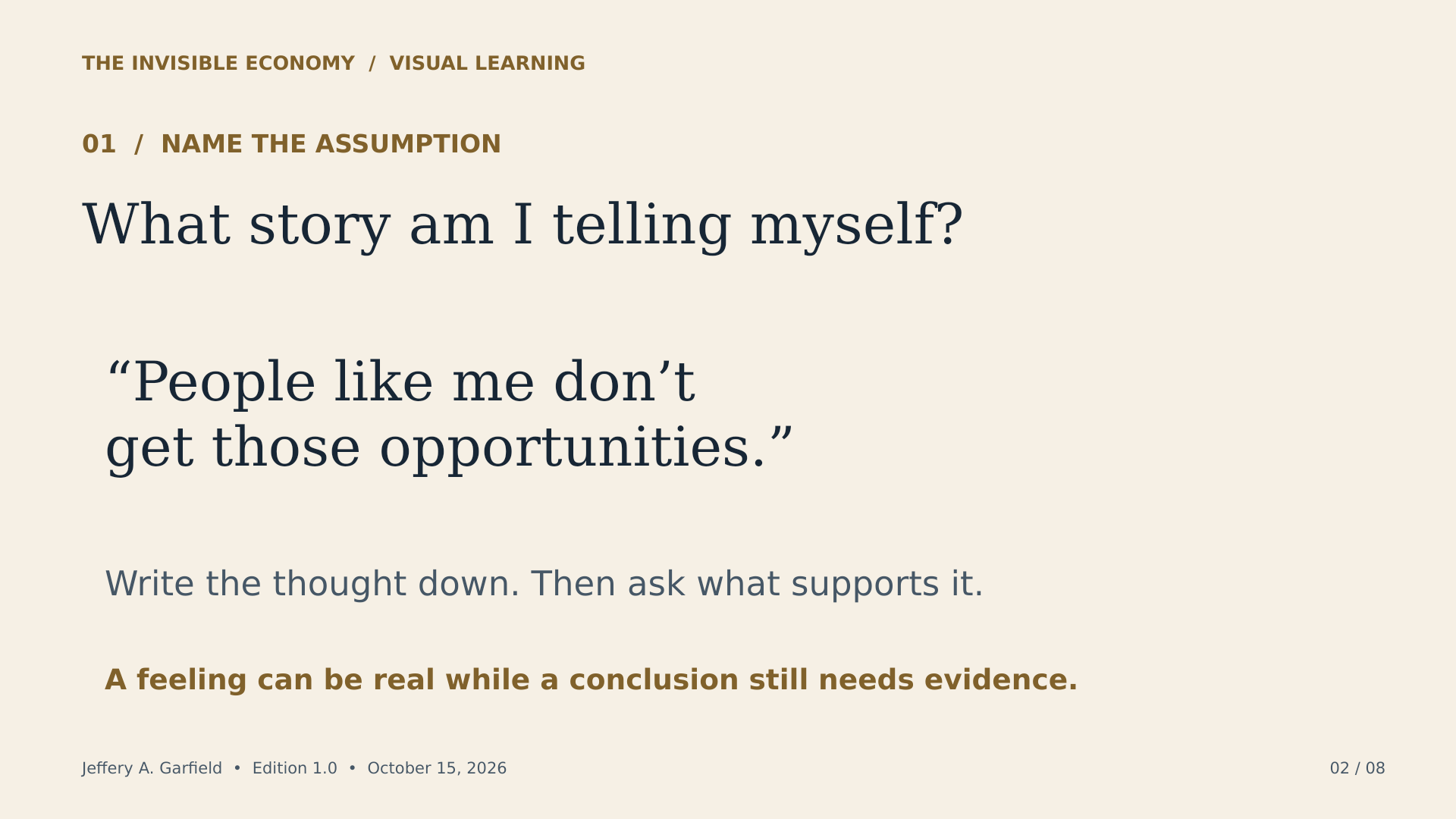
“People like me don’t get those opportunities.”
“I wouldn’t even know where to start.”
Sometimes the first obstacle arrives before we have read the requirements, asked a question or discovered who makes the decision. We encounter an unfamiliar process and turn uncertainty into a conclusion about ourselves.
Applied Infrastructure Literacy offers a useful place to begin: What am I assuming about myself—and what do I actually know about the system?
The distinction matters. “I cannot do this” might mean that we lack information. It might mean we need help with an unfamiliar procedure. It might also describe a genuine barrier: cost, time, eligibility, inaccessible services or an institution that does not provide a workable route.
Finding out which one we face changes what a useful next step looks like.
Confidence can influence the investigation
Research on identity-based motivation examines how people’s sense of who they are can influence their actions and their interpretation of difficulty. Oyserman and Destin describe a model in which these connections depend on context. Difficulty may be interpreted as a reason to persist, or as a signal that an activity is not for someone like us. Much of the intervention evidence in their article concerns educational settings.[1]
That research invites a question; it does not give us a formula for controlling life through belief. The exercise here is an original educational application, not a tested promise that five questions will change a person’s income or remove an institutional barrier.
Consider a fictional adult thinking about a training course. The first reaction is, “I could never go back to school.” But what exactly would going back require? Which entry requirements apply? What are the full costs? When does the class meet? Is there financial assistance, and who qualifies? What would happen to work hours, transport and childcare?
A conversation with the course office might reveal a workable route. It might reveal that the current schedule is impossible. Both answers are useful because they replace an undefined judgment with something that can be examined.
The barrier deserves the right name
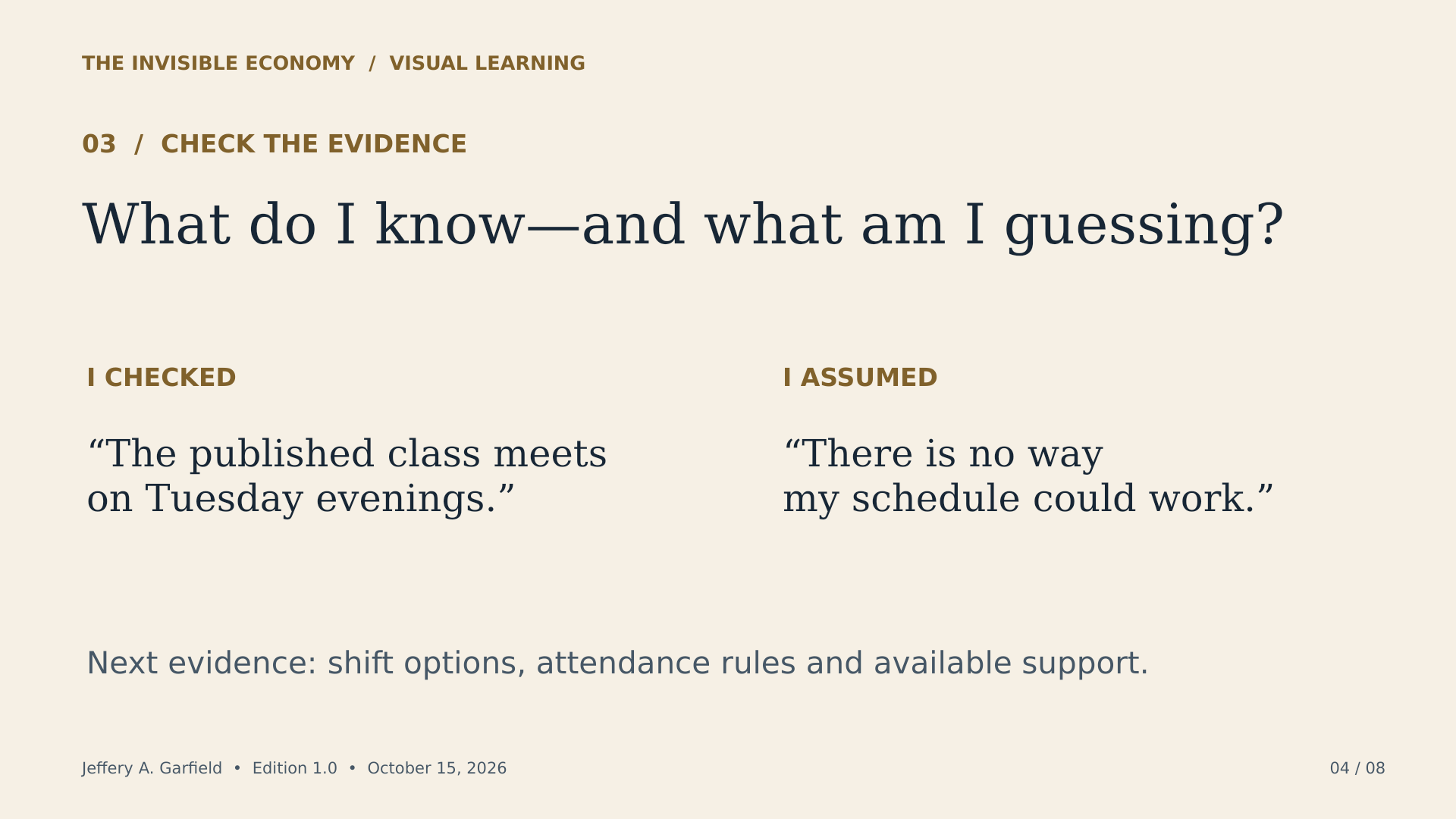
Suppose the course meets on Tuesday evenings and the person works that shift. That is a scheduling conflict. If no shift change, alternative course or care arrangement is available, confidence alone cannot solve it.
Calling the problem a lack of ambition would hide the connection that needs attention. Naming the constraint makes it possible to ask for the relevant support—or to decide that a different route is necessary.
The same caution applies to claims about self-worth and money. A longitudinal study of more than 4,000 adults in the Netherlands found associations between income and self-esteem over time. That is not evidence that each person has a fixed psychological ceiling on earnings.[2] Relationships in a population do not tell us why a particular individual is underpaid, excluded or unable to meet a bill.
Five questions worth keeping
Start with one decision, rather than trying to explain your entire life at once.
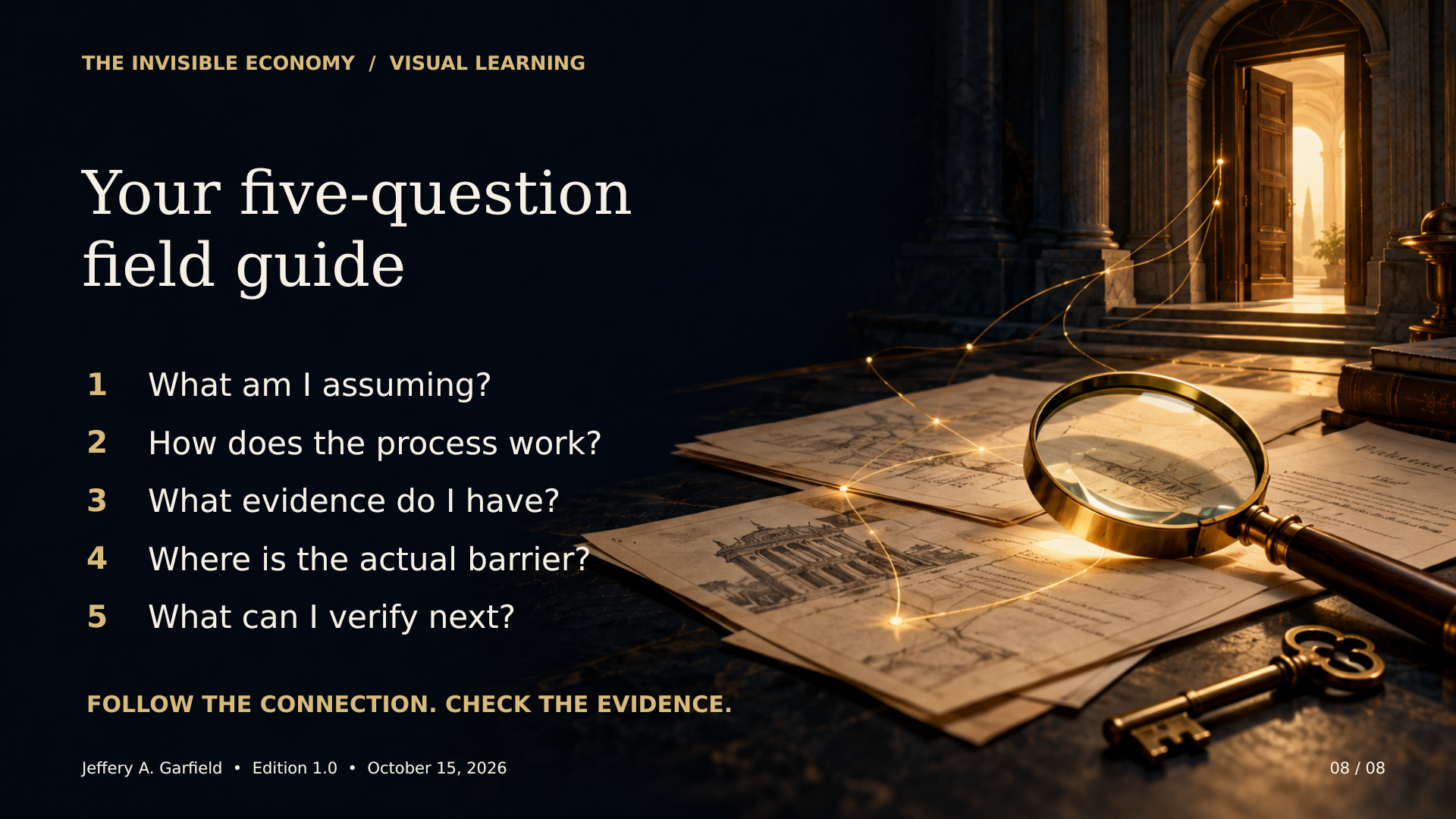
- What am I assuming? Write down the thought in your own words. Be specific enough to examine it.
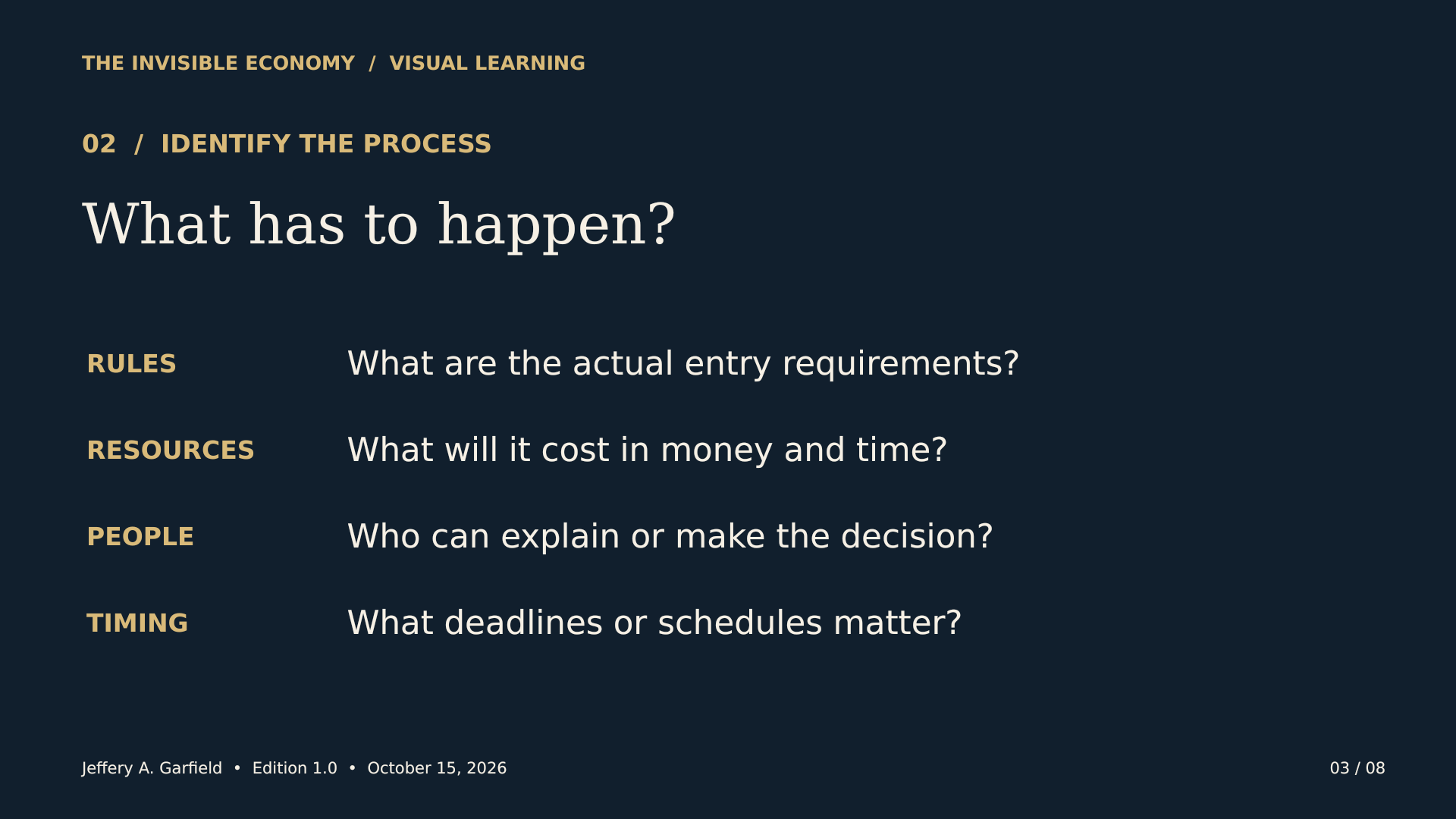
- How does the process work? Identify the rules, resources, people and timing. Ask who owns the decision and where the current requirements are recorded.
- What evidence do I have? Separate what you checked from what you expect. “The class meets on Tuesday” and “no arrangement could ever work” are different kinds of statements.
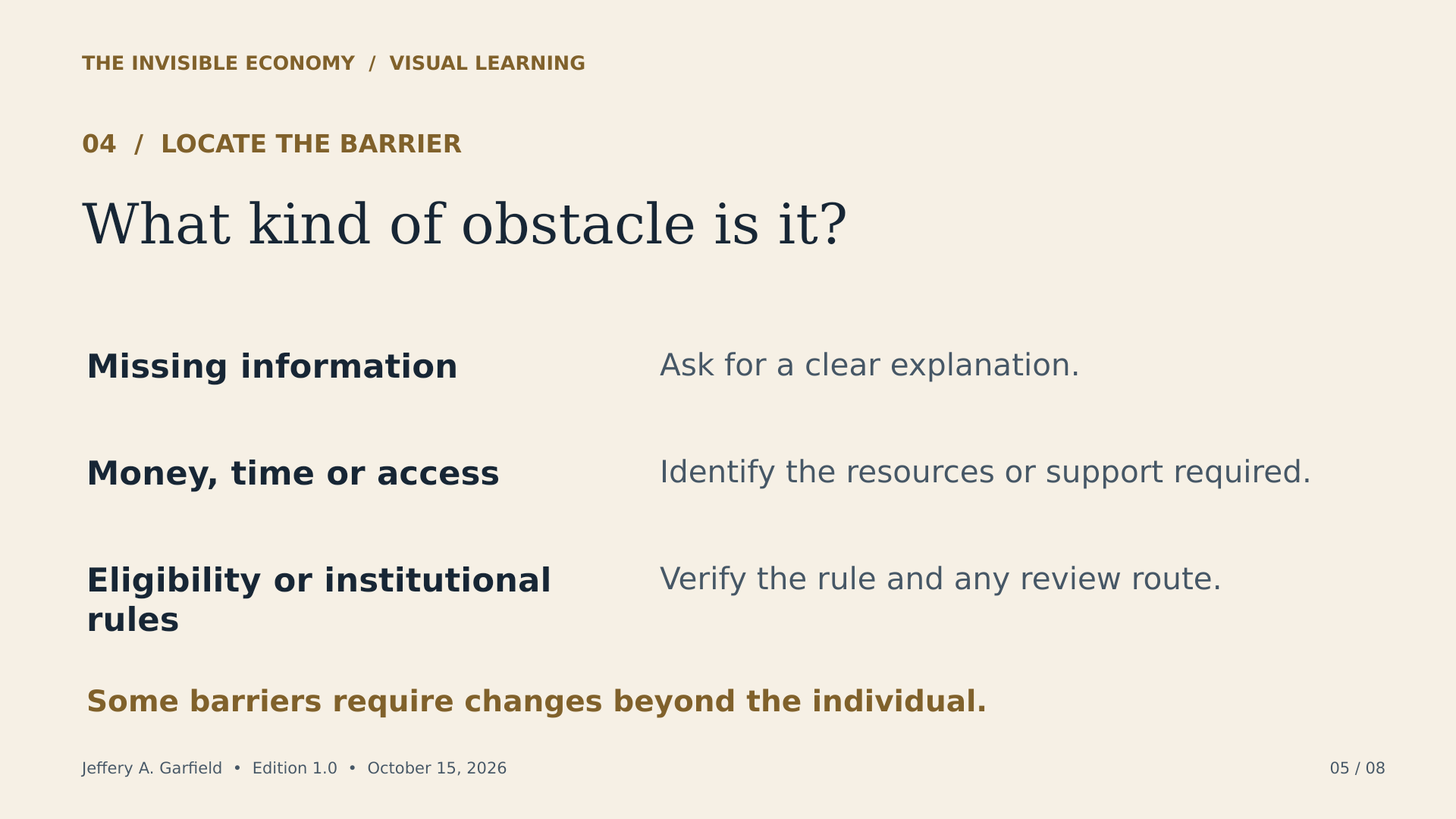
- Where is the actual barrier? Is it missing information, money, time, access, eligibility or an institutional practice? More than one may apply.
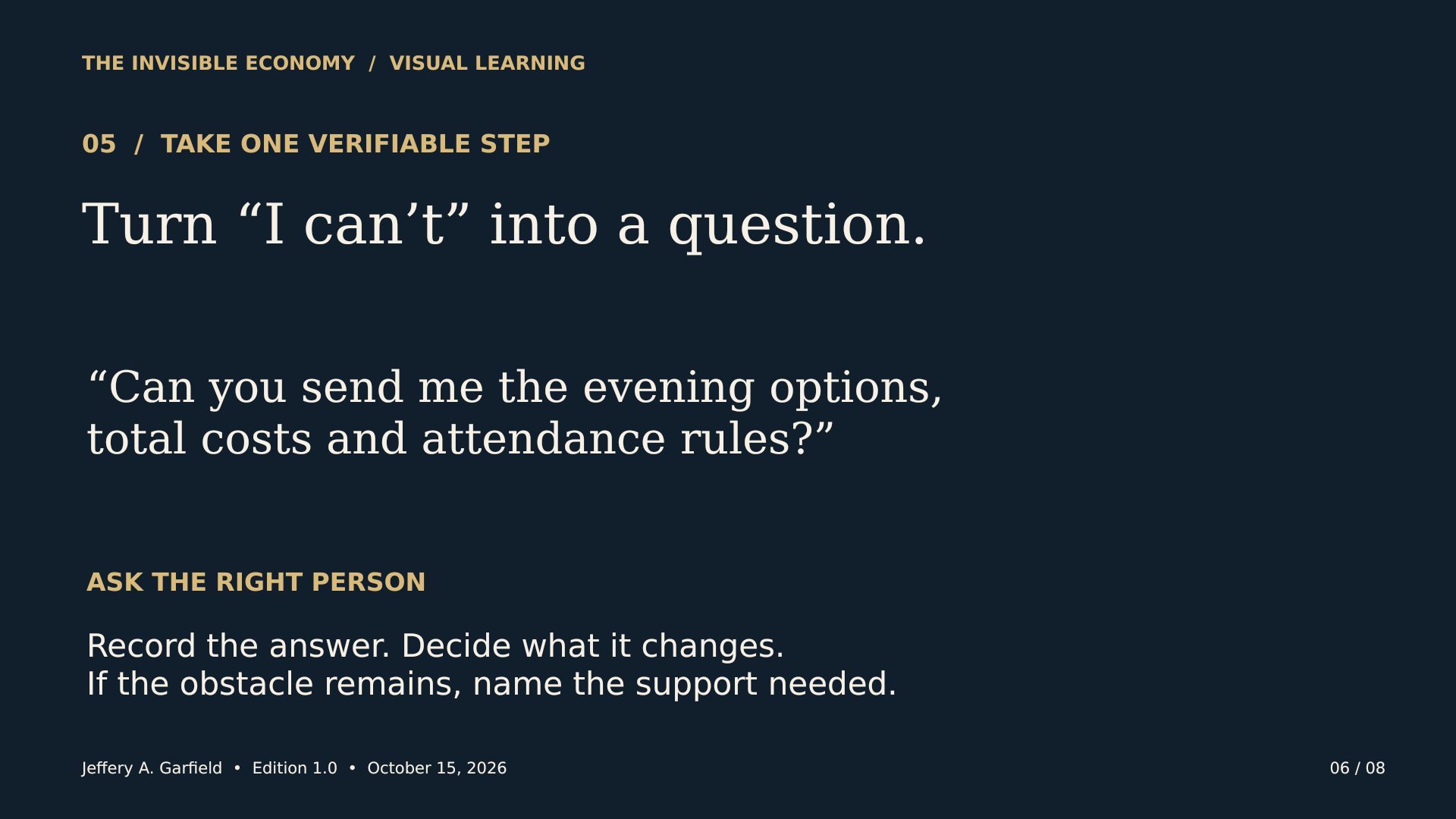
- What can I verify next? Choose one useful action: request the written requirements, ask for the full cost, check an attendance rule or find the person responsible for a missing record.
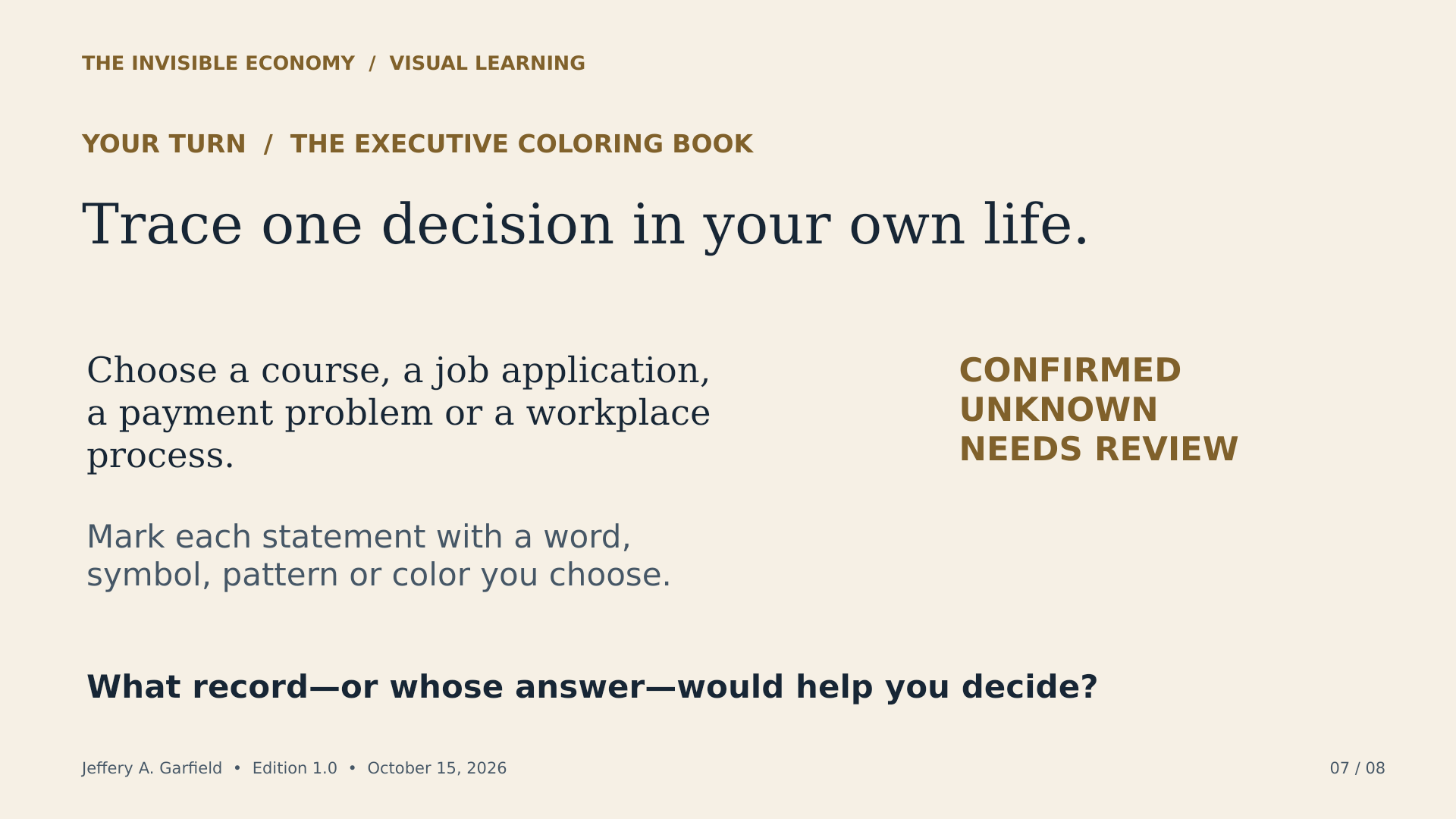
You can make a visual record by marking each statement “confirmed,” “unknown” or “needs review.” Use words, symbols, patterns or colors. The purpose is to make the investigation easier to follow in a form that works for you.
Learning how a process works will not guarantee the outcome you want. It can help you ask a better question, locate the right person and recognize when the system itself needs to change.
Before you turn an unfamiliar system into a verdict about yourself, find out how it works.
Learning article sources
- Daphna Oyserman and Mesmin Destin, “Identity-based motivation: Implications for intervention,” The Counseling Psychologist (2010). Full author manuscript.
- Wiebke Bleidorn et al., “Self-Esteem and Income Over Time,” Psychological Science (2023). Research article. Observational longitudinal evidence; the article above does not claim universal or individual causation.
Companion activity: investigate one decision
The Executive Coloring Book — adult learning exercise
Choose a course, a job application, a payment problem or a workplace process. No personal financial or health disclosure is required. Color is optional; each category has a text label.
| My investigation | My notes |
|---|---|
| The decision I am facing | |
| My initial assumption | |
| The rule or process I need to understand | |
| Evidence I have already checked | |
| What remains unknown | |
| The actual barrier, if known | |
| The person or record that could help | |
| One next action and when I will take it | |
| What the answer changed |
Discussion prompt: Did the new evidence change your assumption, identify a resource you need or show that the process itself needs attention?
Write on a printed copy or type notes here. Notes are not submitted to the website and may be lost when you leave or reload the page.
Your eight-card field guide
Open a card to view it at full size, or download the PDF above. The article and activity provide the same investigation in readable text.
Follow a current example
Producer Inflation Rose. Where Does the Pressure Go Next? traces a headline through invoices, financing and decisions.