You make business decisions.
Look more closely at the resources, commitments, information, and dependencies behind the next opportunity.
The Invisible Economy / Reader Questions
What is the book about? Who is it for? How can its ideas help you examine the systems around you?
Start with the questions you already encounter in your work and everyday life.
Look more closely at the resources, commitments, information, and dependencies behind the next opportunity.
Examine how authority, incentives, and coordination influence what people can actually accomplish.
Explore the relationships beneath familiar events, from a payment going through to a product reaching its customer.
Start with a sales and operations example or a short website insight to explore the perspective. Then visit the book listing to review the description, current price, and available formats.
Reader questions
The Invisible Economy: Learning to See the Invisible Systems That Shape Our World explores the systems and relationships beneath visible outcomes. Its focus includes infrastructure, capital, information, coordination, authority, incentives, trust, and institutions—and how recognizing their connections changes the questions we ask.
It is for curious readers who want to look beneath headlines, transactions, and everyday results. Business leaders and owners can use its systems-thinking perspective to examine delivery promises, cash timing, decision authority and conflicting incentives. Professionals, students and readers interested in institutions can apply the same questions to the systems around them.
Start with curiosity about how things work. You can approach the ideas through familiar situations: a payment going through, a product reaching a customer, or an organization making a promise. Ask what resources, rules, information, and relationships make that outcome possible.
Its subject is broader than banking. Banking is one setting in which capital, trust, authority, and institutional relationships become visible. The same kinds of questions can also illuminate a supply chain, a business operation, or an everyday service.
Reader questions
Infrastructure Literacy means recognizing and understanding the systems, capital, information, authority, incentives, trust, and institutional relationships beneath visible outcomes.
Applied Infrastructure Literacy connects that understanding to practical judgment and action. Once you recognize the underlying system, ask what it implies for a decision: what needs to work, who has authority to act, what evidence is missing, and what should happen next.
Physical structures are part of infrastructure. This perspective also considers the arrangements that help systems function: information flows, funding, rules, responsibilities, coordination, and trust. Many of those arrangements are less visible than the outcome they support.
Look for dependencies: what must happen before something else can work? Identify who controls a decision, which incentives shape behavior, and what information each participant can see. Then separate what is established from what is being assumed.
Reader questions
Choose one familiar outcome, such as a delivery arriving on time. Trace the people, resources, information, and commitments it depends on. Ask where a delay could begin, who would notice it, and who could respond. Keep the exercise small enough to examine carefully.
It offers questions for examining a decision in context. Before committing to a larger order, for example, consider supplier capacity, production timing, payment terms, decision authority, and the evidence behind delivery promises. The practical aim is clearer reasoning about the conditions needed for success.
No. Information may be incomplete, people may respond differently than expected, and conditions can change. Making dependencies and assumptions visible gives you a clearer basis for reviewing and revising a decision.
Reader questions
Jeffery A. Garfield is the author of The Invisible Economy and a consultant specializing in de novo bank formation. His work connects an interest in institutions and their underlying systems with practical questions about judgment and action.
Use the Amazon U.S. link below to visit the book listing and check the available formats and current price. The About This Book page provides an introduction to the book and its scope.
Visit the author page for an introduction to Jeffery A. Garfield, or follow the LinkedIn profile linked below for his professional presence and writing.
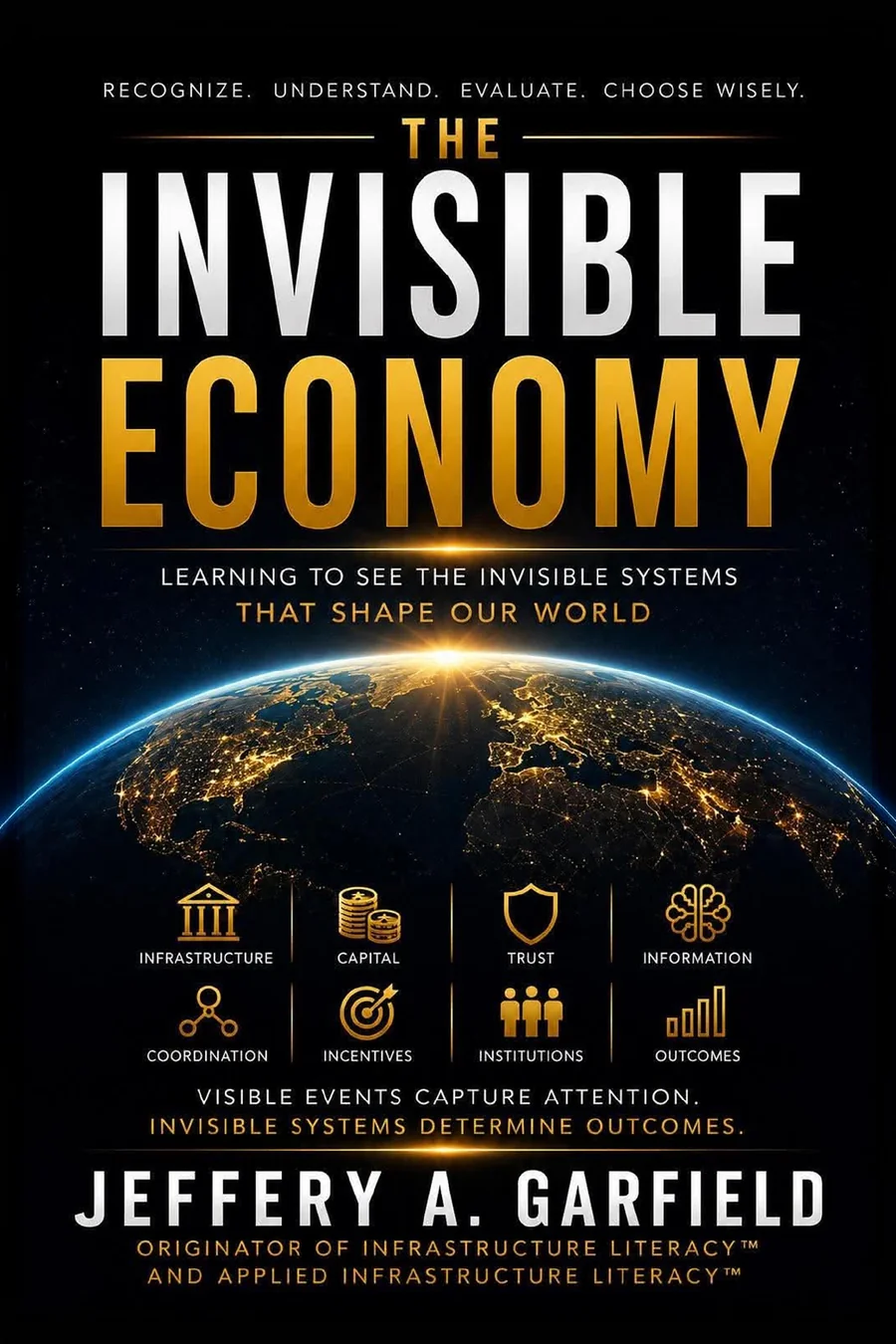
Begin with the book
Learning to See the Invisible Systems That Shape Our World
Recognize the relationships beneath the result. Explore how infrastructure, capital, trust, information, coordination, incentives, and institutions shape the world we experience.
Keep exploring
Recognize the underlying systems and relationships.
Applied Infrastructure LiteracyConnect understanding to practical judgment and action.
About Jeffery A. GarfieldMeet the author and explore his professional background.
Connect on LinkedInVisit Jeffery’s professional profile and writing.