Systems
How the parts connect and depend on one another.
An introduction to Infrastructure Literacy
Infrastructure Literacy is the ability to recognize the systems, capital, information, authority, incentives, trust, and institutional relationships beneath visible outcomes.
What it means
A purchase, a delivery, or a business decision is easy to observe. The arrangements supporting it are often less obvious. Infrastructure Literacy asks us to look at those arrangements: who provides resources, who has authority, how information moves, and which relationships keep the activity working.
How the parts connect and depend on one another.
The resources that fund activity and absorb risk.
What people know, share, verify, or fail to see.
Who may decide, authorize, or enforce a rule.
What encourages people to act in particular ways.
What allows people to rely on commitments and evidence.
The organizations and relationships that support activity.
How separate participants align their actions.
Look beyond the surface
A branch building, a delivery truck or a communications tower is visible. The funding, decision authority, records, agreements and coordination that make it useful are often harder to see. In Jeffery A. Garfield’s framework, Infrastructure Literacy examines those connections together.
Recognizing an asset is a starting point. Understanding who can use it, under what conditions, and what must keep working reveals the system behind it.
Relationships across systems
Interconnected infrastructure literacy describes a useful question within this framework: how does a change in one system affect the others? Banking, payments, communications, transport and business operations meet at shared dependencies.
Consider a hypothetical manufacturer waiting for a customer payment. A delay may change its purchasing schedule, affect a supplier’s production slot and move the promised delivery date. Following those connections helps identify where someone can act and which evidence would show that the problem is resolved.
Map the handoffs: who provides the resource, who receives it, what information travels with it, and what happens if it arrives late. Then connect each important dependency to a responsible person and a practical response.
An application of the framework
Here, Banking Infrastructure Literacy means understanding how a bank’s capital, governance, people, permissions, information and operating arrangements fit together. It brings the institution behind the branch or banking app into view.
For a proposed community bank, useful questions include: Which decisions belong to the organizing board? Who will lead the institution? Which approvals remain outstanding? What evidence supports the capital plan, staffing assumptions and readiness of service providers?
The purpose is to connect the pieces and identify unfinished work. A proposed opening date becomes more useful when each dependency has an owner and evidence of completion.
Read: Why a Bank Is More Than an App · Apply it to a banking decision
Follow the money and its conditions
Here, Financial Infrastructure Literacy means understanding the arrangements through which money is funded, moved, recorded and made available. It connects payments, credit, settlement, working capital and the institutions supporting them.
Start with a practical question: when does a reported amount become money someone can actually use? Trace the participants, payment terms, processing steps, records and timing. Then ask who can investigate a delay or resolve a discrepancy.
This extends a familiar money question into a systems question. A sales figure tells us one thing; the path from order to delivery to collected cash tells us more about the business’s ability to meet its commitments.
Read: Your Payment Says Complete. Where Is the Money? · Apply it to a cash-flow decision
Everyday examples
Choose an example to look beneath the surface. These are illustrative scenarios.
A simple delivery is the final step in a much larger sequence.
Look closer: Where would a delay begin, and who would notice first?
The checkout screen shows a result. Several participants support it.
Look closer: Which information and permissions must be in place for the payment to proceed?
More sales can create new demands before the customer pays.
Look closer: Can the supporting system handle the order as well as the sales team can win it?
From seeing to doing
Applied Infrastructure Literacy connects an understanding of underlying systems to practical judgment and action.
Use these questions as a starting point when examining a decision, an institution, or an unexpected result.
Continue with the book
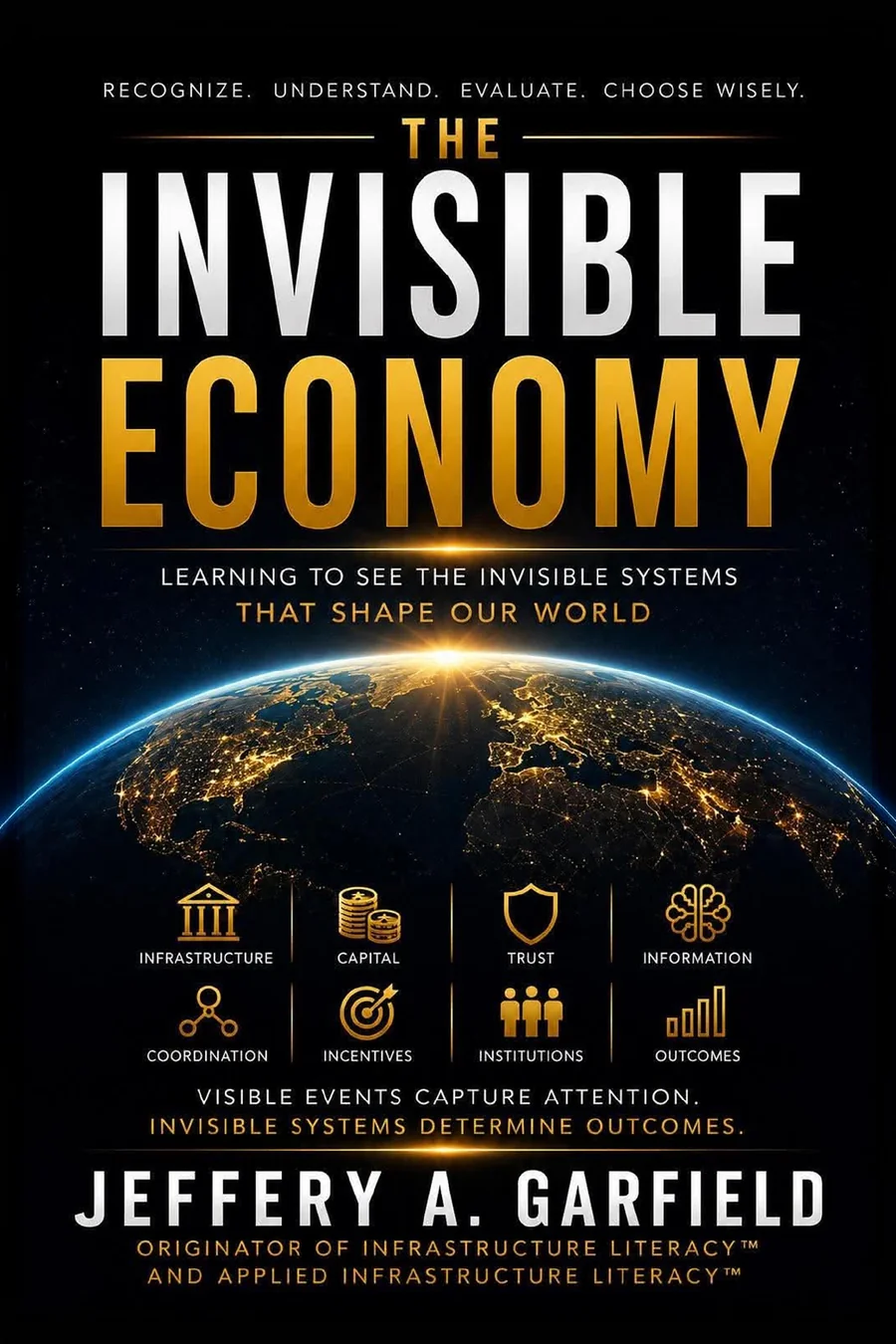
Learning to See the Invisible Systems That Shape Our World
Jeffery A. Garfield’s book explores the structures and institutional relationships beneath visible outcomes. His work connects Infrastructure Literacy with practical judgment and his consulting focus on de novo bank formation.
Common questions
In this framework, infrastructure also includes financial, informational, organizational, and institutional arrangements—the relationships that support visible activity.
Infrastructure Literacy develops recognition and understanding. Applied Infrastructure Literacy connects that understanding to judgment and action.
Jeffery A. Garfield is the author of The Invisible Economy and a consultant specializing in de novo bank formation. Visit his author page or LinkedIn profile to learn more.