Infrastructure Literacy: Definitions, Scope and Core Principles
A shared language for recognizing systems and applying that understanding to practical decisions.
Purpose and scope
Visible outcomes rarely explain themselves. A payment arrives, a project stalls, an institution earns confidence, or an opportunity disappears. Each result has a history of decisions, relationships, constraints, and dependencies beneath it.
This paper sets out the working language used across this website. Its purpose is practical: help readers recognize that underlying architecture and ask more useful questions about it. It is an explanatory website edition, separate from earlier unpublished essay drafts.
Three connected ideas
The Invisible Economy
In this body of work, the invisible economy refers to the underlying systems and relationships that shape visible economic outcomes. Capital, information, authority, incentives, trust, and institutions interact with human decisions. Much of that interaction escapes attention when we focus only on the final result.
Infrastructure Literacy: see the architecture
Infrastructure Literacy is the ability to recognize the systems and relationships beneath visible outcomes. It directs attention to what a result depends on: who decides, what resources are available, how information moves, and what people have reason to do.
Applied Infrastructure Literacy: use what you see
Applied Infrastructure Literacy connects that understanding to practical judgment and action. Recognition becomes useful when it changes a question, clarifies a dependency, informs a decision, or helps evaluate whether an intervention worked.
Core principles
- Begin with an observable outcome. Describe what happened before deciding why. Separate the event from your explanation of it.
- Trace relationships and dependencies. A resource or decision may be available in one part of a system and unavailable where it is needed. Examine the connections.
- Distinguish authority from capability. Permission to act and the ability to perform are separate questions. Neither, by itself, demonstrates a successful result.
- Ask for evidence. Identify what supports an explanation, what remains uncertain, and what observation could change your view.
- Account for incentives and human behavior. Written procedures operate through people. Consider what the system encourages, rewards, delays, or makes difficult.
- Revisit assumptions. An arrangement that worked under one set of conditions may need revision when the conditions change.
A practical sequence
See it. Understand it. Build it. Improve it. Future-proof it.
See it: recognize the outcome and the relationships around it. Understand it: investigate how those relationships operate. Build it: put the necessary people, resources, decisions, and controls in place. Improve it: compare intended results with observed performance. Future-proof it: prepare to adapt as dependencies and assumptions change. That final step is a discipline of continuing review, rather than a promise that uncertainty can be eliminated.
What application looks like
Consider an illustrative business that repeatedly promises a delivery date before checking supplier capacity. The visible problem is a late delivery. The underlying issue may be the order of commitments: sales promises first, capacity confirmation later.
Infrastructure Literacy identifies that dependency. Applied Infrastructure Literacy asks whether the commitment process should change, who has authority to change it, and how the business will assess the result. The explanation remains a hypothesis until evidence supports it.
Limits and use
This framework offers a way to organize observation and judgment. It does not establish that every outcome has a single cause, that every hidden relationship is intentional, or that a diagram proves a causal claim. Multiple explanations may fit the same result.
Use the framework to make assumptions visible, identify questions worth investigating, and connect decisions to evidence. The governing question remains: What invisible system is shaping the visible outcome?
Continue with the book
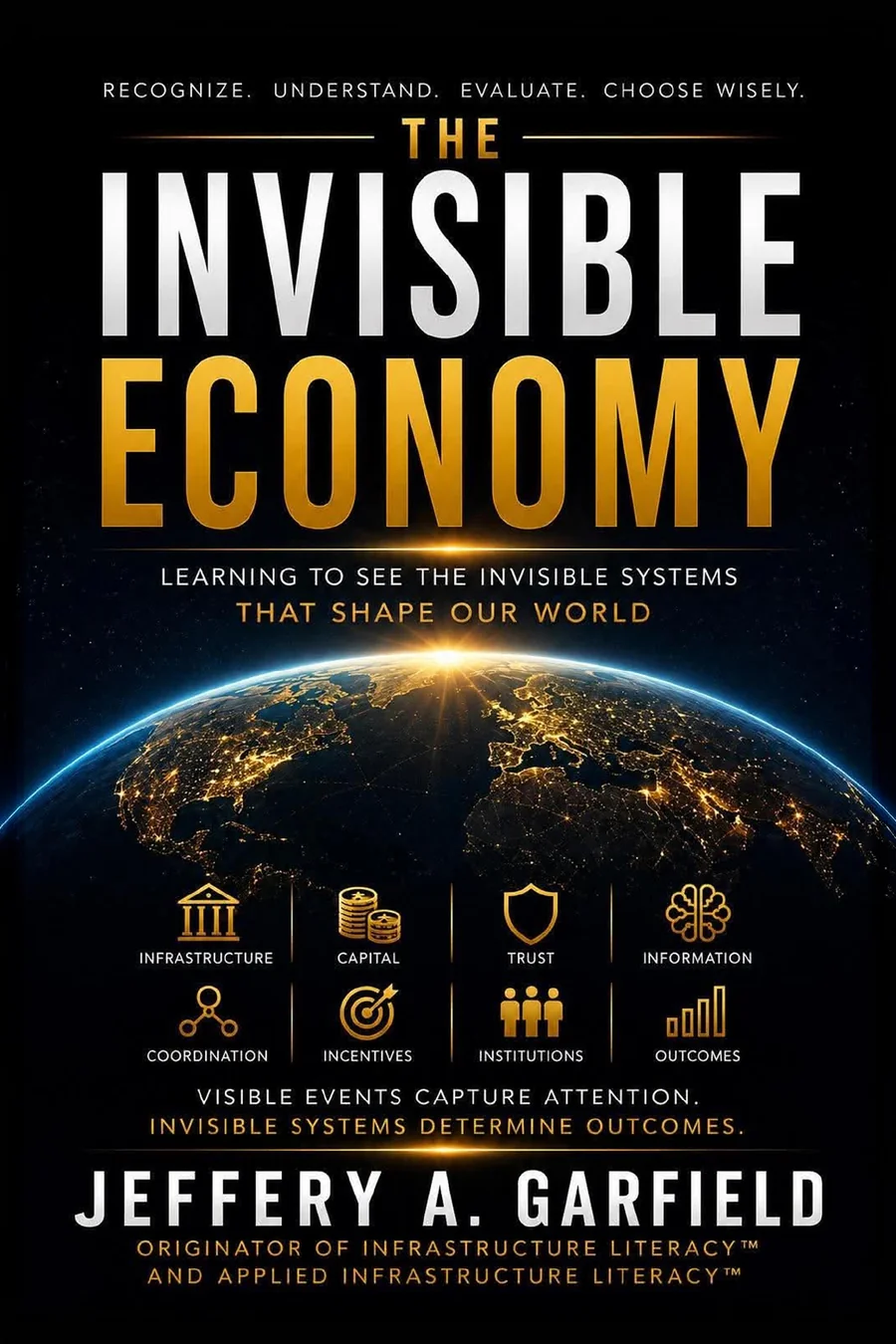
The Invisible Economy
Learning to See the Invisible Systems That Shape Our World
Explore the systems and relationships beneath visible outcomes—and the questions they raise for practical judgment.
Buy the book on Amazon U.S. ↗Is this book for me? →