Who Owns
the Audience?
Money, power, and rules in the creator economy.
Case format: An illustrative business scenario informed by public platform guidance. This is not a reported investigation of a named creator house. No participant earnings are asserted.
The camera captures the personality. The business depends on what happens outside the frame: account access, distribution, payment, agreements, and the rules that keep people working together.
A creator house makes these relationships easier to see. Several people share a location, equipment, production work, and attention. To an audience, it may look like a group of friends making content. Behind the scenes, it raises questions familiar to any organization: who can decide, who gets paid, and what survives when someone leaves?
The audience is a relationship, not a possession.
“Who owns the audience?” is a useful provocation. People retain their choices. The practical business questions concern control of accounts, access to distribution, permission to contact subscribers, and rights to use content. Those are different assets with different constraints.
A large following does not establish control over the platform carrying it. YouTube’s published Partner Program guidance ties monetization to eligibility, review, and continuing compliance with its policies.[1] The analytical implication is straightforward: reach and permission to earn are separate dependencies.
A hypothetical house with a very real decision.
Imagine four creators sharing production costs and a collective channel. One member attracts most of the new viewers; another handles editing and publishing. The login belongs to the person who opened the account. The group has discussed splitting money but has not documented which costs come first.
Then the most visible member leaves. Can the group keep using earlier footage? Who can access the account? What happens to money earned before the departure but paid afterward? The scenario contains no measured financial results. Its purpose is to show how unresolved infrastructure can turn popularity into a dispute.
Follow the money beyond the headline.
Revenue figures need a defined period, a clear source, and a distinction between gross receipts and profit. A useful examination would trace platform charges, refunds, production expenses, shared overhead, participant payments, and taxes. It would also ask when cash actually becomes available.
For this hypothetical group, the next step is a documented reconciliation: receipts, deductions, approved expenses, each participant’s allocation, and the remaining cash. No earnings projection is needed to see the importance of that record.
Conduct rules are operating decisions.
“Behave professionally” sounds reassuring until people disagree about its meaning. A workable governance discussion would identify observable conduct, who reviews concerns, how affected people respond, and how conflicts of interest are handled. It should distinguish a safety concern from a creative disagreement or a commercial disappointment.
Questions for a group to resolve include consent to filming and publication; privacy in shared spaces; harassment and safety reporting; approval of sponsorships; access to shared accounts; and procedures for correction, departure, and disputes. These are discussion topics, not model contract clauses or a determination of enforceability.
Commercial disclosure is another part of the system. FTC guidance calls for clear disclosure of material relationships when endorsing products.[2] In practice, someone must be responsible for checking that a disclosure accompanies the relevant promotion.
Reputation travels across shared relationships.
A collective brand creates shared exposure. A participant’s public conduct can affect how audiences and business partners view the group. An operating plan should therefore address who can speak for the collective and how the group responds to a substantiated problem. A broad label such as “bad behavior” alone does not resolve those decisions.
The same lens can be applied to podcast networks, fitness creators, and lawful adult-content businesses. In an adult-content context, consent, privacy, platform eligibility, and participant boundaries deserve particular attention. This article contains no explicit material and does not equate lawful adult work with illicit economic activity.
Apply Infrastructure Literacy.
- Map authority. Who controls the channel, money, publishing decisions, and dispute process?
- Trace dependencies. Which platform, payment service, person, or agreement could interrupt operations?
- Test the records. Can participants reconcile revenue, expenses, permissions, and access?
- Consider departure. What happens to content, compensation, and account access when the relationship ends?
- Choose a bounded improvement. Resolve one material gap and verify that the new process works.
Infrastructure Literacy helps reveal these relationships. Applied Infrastructure Literacy asks what judgment and action they support. In this scenario, documenting account access and revenue allocation may be more immediately useful than chasing the next surge of attention.
Attention can open the door. The arrangements behind it determine whether the business can keep operating.
Sources and scope
- YouTube: Partner Program overview and eligibility — platform requirements, review and ongoing compliance.
- FTC: Disclosures 101 for Social Media Influencers — material relationships and clear disclosures.
Sources reviewed October 5, 2026. Platform terms can change. The hypothetical scenario and analytical questions are editorial interpretation; the sources do not establish the finances or conduct of any named collective.
Educational commentary, not legal, tax, investment, or individualized business advice. References to third parties do not imply affiliation or endorsement.
Explore Applied Infrastructure Literacy →
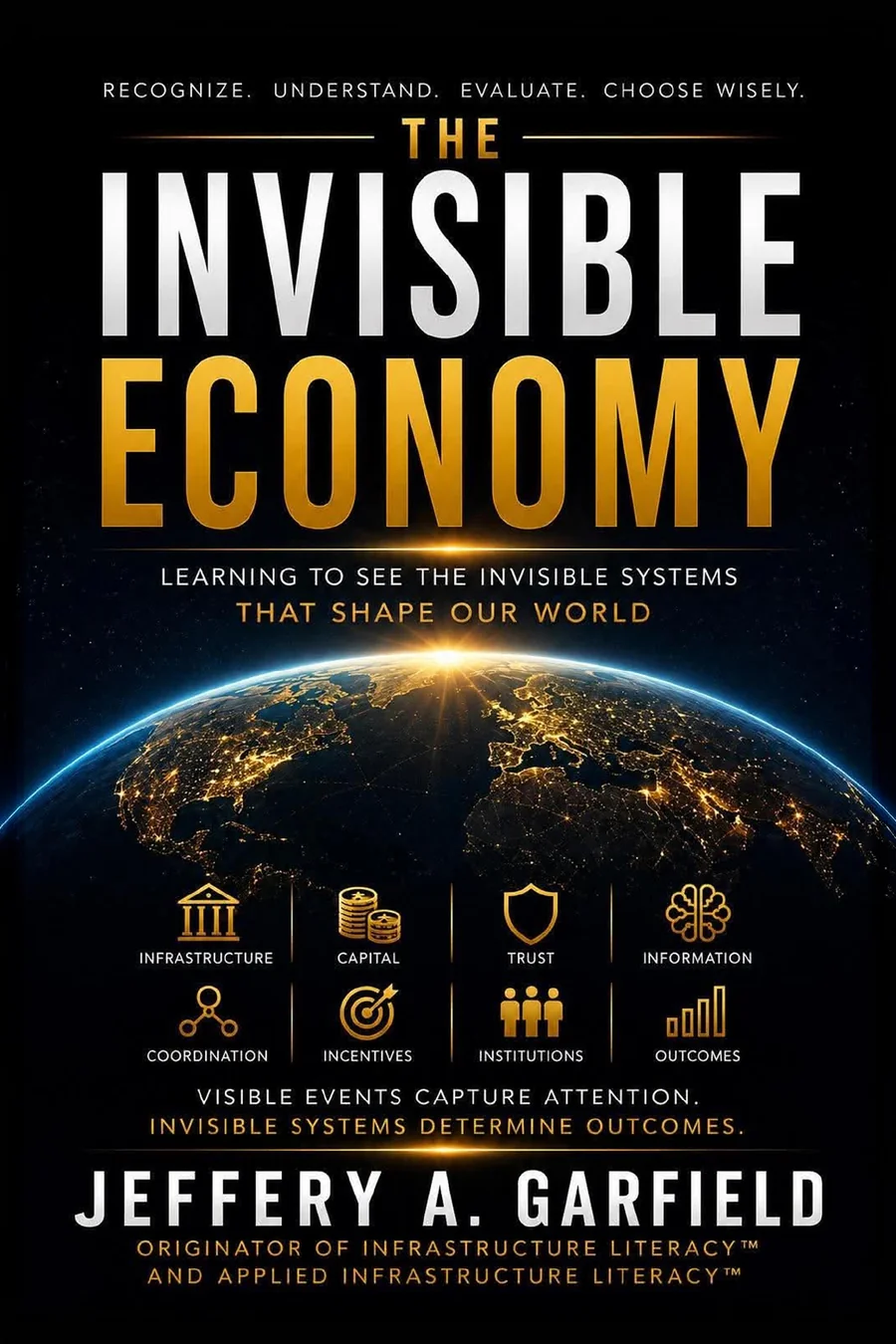
Continue with the book
The Invisible Economy
Learning to See the Invisible Systems That Shape Our World
Explore the systems and relationships beneath visible outcomes—and the questions they raise for practical judgment.
Buy the book on Amazon U.S. ↗Is this book for me? →